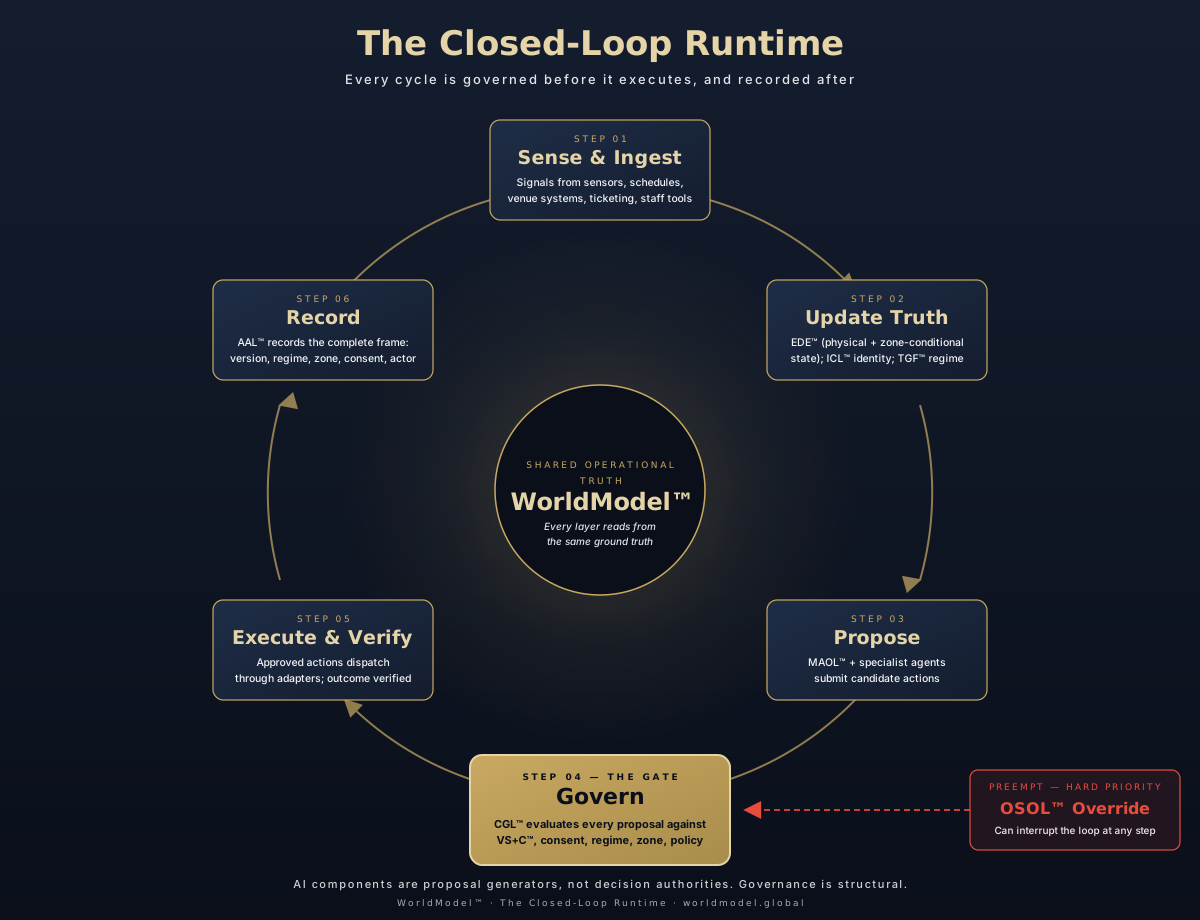
Every cycle is governed before it executes, and recorded after. Six steps, one gate, one shared operational truth at the center, and OSOL™ preemption available at any step.
The runtime cycle is what makes the architecture an operational system rather than a static taxonomy. Signals are sensed and ingested. The shared operational truth is updated through EDE™ (which carries the zone-conditional governance state) and ICL™. TGF™ resolves the active temporal regime for the current moment — operational, calendar, performance and show, or sensor-triggered — and supplies CGL™ with the active rule set. MAOL™ and specialist agents propose candidate actions. CGL™ governs every proposal at the gate — evaluating against VS+C™, consent state, jurisdictional constraints, the TGF™-resolved regime, the EDE™ zone-conditional state, and operational policy — before execution may occur. Approved actions dispatch with outcome verification. AAL™ records the governed decision against the complete frame: policy version in force, active TGF™ regime, EDE™ spatial context, consent state, rule set evaluated, action taken, and actor.
The governance gate at step 4 is rendered in solid gold because it is the structural enforcement point that distinguishes governed AI from collections of integrated subsystems. AI components are proposal generators, not decision authorities. Final decision is held by the governance layer, not by the proposing component. This is an architectural property, not a policy assertion.
OSOL™ can interrupt the loop at any step. The coral preemption arrow shows this graphically: when a safety-relevant condition is signaled, the loop yields immediately, regardless of which step it is currently executing.