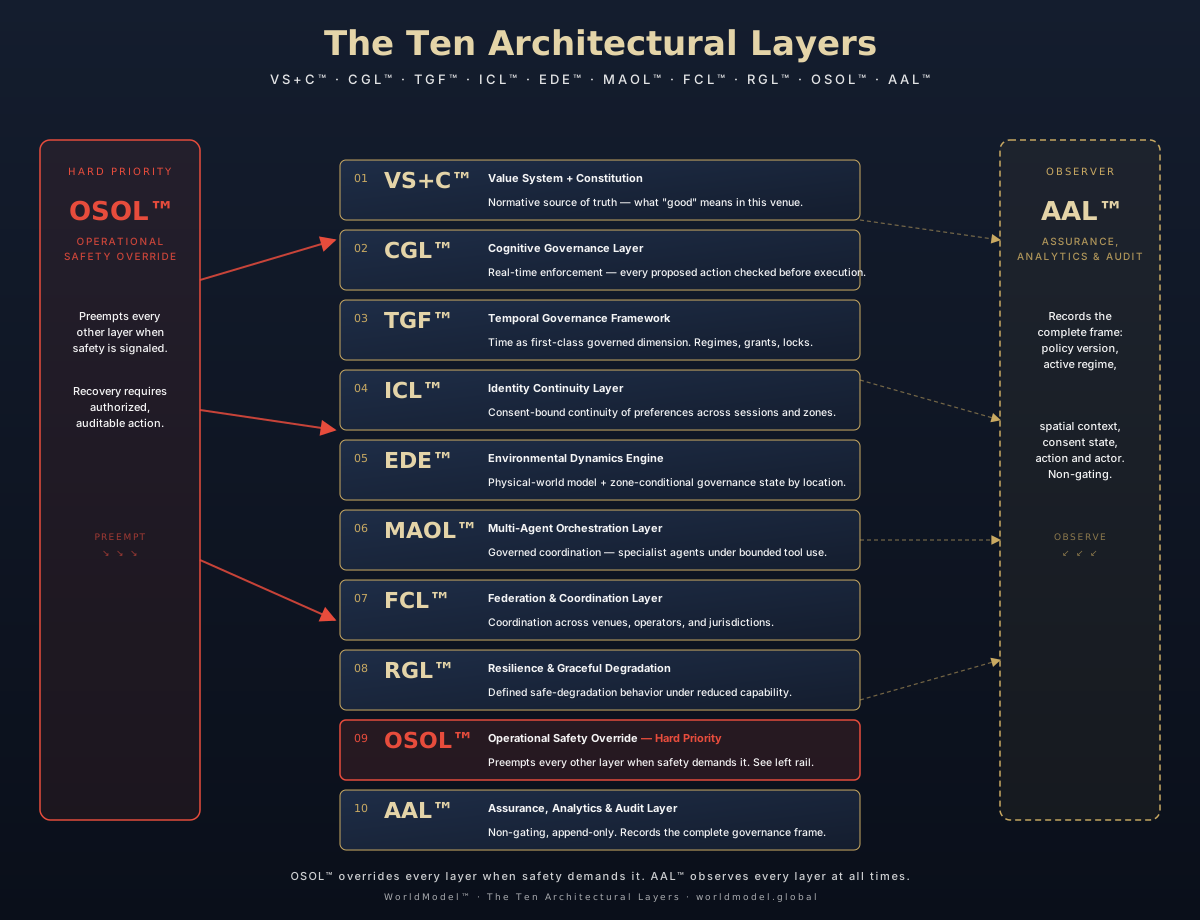
The structural form of the WorldModel™ architecture. Ten layers, each with a defined role, an enforceable interface, and a precedence relationship to the others. OSOL™ takes hard priority. AAL™ observes everything.
The ten architectural layers organize the work that a governed venue must do. VS+C™ declares the normative ground. CGL™ enforces it at runtime. TGF™ governs operational, calendar, performance and show, and sensor-triggered regimes across time, plus time-bounded grants and mutual-exclusion windows on shared resources. ICL™ carries identity continuity under consent. EDE™ maintains the live physical-world model plus the zone-conditional governance state. MAOL™ orchestrates specialist agents under governance. FCL™ coordinates across venues without collapsing local authority. RGL™ defines safe behavior when capability is reduced. OSOL™ preempts every other layer when safety demands it. AAL™ records every governed decision against the complete frame: policy version, active TGF™ regime, EDE™ spatial context, consent state, rule set evaluated.
Two layers operate structurally outside the normal stack relationship. OSOL™ appears in the left rail with hard-priority override arrows striking into the stack — it is the only layer that can interrupt every other layer when a safety-relevant condition is signaled. AAL™ appears in the right rail as an observer with dashed arrows reaching back toward every layer it captures. The asymmetry is structural: one layer can override, one layer must always witness, and the rest sit in functional sequence between them.
The full canonical definitions of every layer are documented in the Reference.